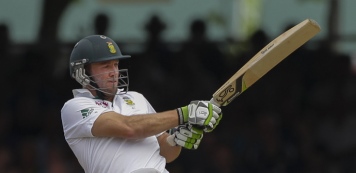
South Africa
The four best bowlers over the next five years
Picking the bowlers was much harder than picking the batsmen and all-rounders. We’re not going to pretend that we’re 100% happy with what we’ve come up with because that would be dishonest and we save the dishonesty for getting out of social events.
Dale Steyn, South Africa, age 26
We’ve still not quite worked out how someone so spindly can be so quick. The fastest bowlers do tend to be whippy, flexible beasts, but even allowing for that, Steyn still looks a bit malnourished. Being quick AND being able to swing the ball makes him more rounded than other bowlers.
Mohammad Asif, Pakistan, 26
There are a lot of variables here. As long as Mohammad Asif can stay fit and stay out of trouble and as long as Pakistan actually get to play against other people; as long as all that happens he’ll take wickets by the big-receptacle-load.
Ajantha Mendis, Sri Lanka, 24
You have to do something a bit mental to get batsmen out on today’s pitches. Even if people work out the mental deliveries Mendis uses at present, he seems like the type who’d just invent another one. Will get lots of wickets with slow, straight deliveries that will confuse batsmen predicting sorcery.
Ishant Sharma, India, 21
Has been a bit ropey of late, but anyone who can make mincemeat out of Ricky Ponting when they’re 19 doesn’t need to improve too much. Ridiculously, he’s still only 21.
Also, just a note to say that the bowler we’re perhaps most excited about, Mohammad Aamer, is more of a bowler for the next 15 years, not the next five. We’re giving him time.
As for the Aussies, they’re all good and all about the right age, but none really stands out. It’s more that we couldn’t pick one in particular than that we couldn’t pick any.
17 AppealsMakhaya Ntini’s 100th Test cap
Makhaya Ntini should make his 100th Test appearance this week.
What strikes us about this is that an African nation’s first black cricketer is still playing.
2 AppealsICC Test rankings system
India have risen to be number one in the rankings and many people will say that the rankings are questionable. Are India the best Test cricket team?
A lot of people say the rankings are meaningless. When they make this criticism, they always do it according to a team’s position. The statement is usually something like ‘there is no way on earth that Australia are only the fourth best’.
Australia are actually third now, but these people should look at the points that the positions are based on rather than the positions themselves. It’s like batting averages. One run here or there doesn’t mean a thing (except to Don Bradman maybe). Similarly, one point in the Test rankings doesn’t mean a lot.
Back when Australia were clearly the best Test side, they were generally ahead by about 15 points. That’s enough. You’re definitely ahead there. Back then, being fourth meant you were a distant fourth. Not so long ago, when Australia were ranked fourth, they were fourth by about a point. That doesn’t really mean anything.
Test cricket’s hierarchy and why shades of grey are good
One of the best things about Test cricket is that the same two teams can produce wildly differing results if they play each other in different countries, on different grounds or even in different weather conditions.
It’s not like Team A are the best and they’ll always beat Team B, who’ll always beat Team C and so on. There are so many different factors that there’s frequently a healthy amount of grey to the answer to any ‘which side is better?’ question.
Look at the rankings in the same way. A point here or there means next to nothing.
9 AppealsMark Boucher at six? This isn’t South Africa

When England took the fourth wicket of what seemed like a mesmerisingly unstrenuous dismantling of the South African batting line-up, we wondered where the real South Africa were. Mark Boucher at six? Where was the breathtaking conservatism for which South African cricket is so renowned?
Think back to the glory days of Shaun Pollock, Nicky Boje and Andrew Hall at eight, nine and ten. The South Africa of old didn’t let the fact that two of those three were utterly mediocre with the ball stop them. Bolster the lower order, just in case – that was the way.
Hopefully they’ve learnt their lesson and dynamism and risk-taking can be put aside once more in favour of the ‘why risk it?’ tactic.
3 AppealsThe five best batsmen over the next five years
The big names are generally old bastards. Who’s next?
Ross Taylor, New Zealand, age 25
Ross Taylor tends to look like he’s the man who’s going to win the match for New Zealand shortly before doing something slightly spacky. Pretty soon those fifties will become hundreds and those hundreds will become double hundreds.
JP Duminy, South Africa, 25
Duminy has barely started in Test cricket, but has the reassuring habit of being exceptional whatever the format. Twenty20′s just for sloggers, is it? Then why is Duminy so effective. The best batsmen are generally the best batsmen in all forms of the game.
AB de Villiers, South Africa, 25
Yes, he is only 25. There are already bowlers in world cricket who’d sooner try and insert a bat handle into their urethra than bowl at vehement letter-C denier, AB de Villiers.
Michael Clarke, Australia, 28
Recently voted ‘most overrated player’ by readers of the Herald Sun, Michael Clarke must be rated really, really, phenomenally highly. Quite clearly following in the footsteps of Border, Waugh and Ponting as an Aussie captain who’s mint with the bat.
Gautam Gambhir, India, 28
Test average after 18 Tests: 36, with one hundred. Test average in the next nine Tests: 94, with seven hundreds. Gautam Gambhir is up and running.
31 AppealsCow corner cricket – Twenty20 matches that push the boundaries
England just couldn’t quite get the 85 runs they needed off the final ball. However, while we give Loots Bosman and Graeme Smith enormous credit for the faultlessness of their hitting, South Africa’s monumental Twenty20 total of 241 was perhaps one step too close to slogging.
We defend Twenty20 cricket from allegations that it’s a mindless slogfest, because generally it’s still the most talented batsmen who fare best. That said, watching Bosman and Smith repeatedly clear the ropes, three things struck us.
- All their big shots went to cow corner – the match revolved around that corner of the pitch
- The fielders were largely bystanders
- The South Africans are ‘built’
Clearly we’re bitter and smarting because England got royally annihilated, but we do think there was a slightly one-dimensional quality to this particular match. The physically stronger side pitched the ball over cow corner more frequently than their opponents.
12 AppealsLoots Bosman and Graeme Smith should play on ‘hard’ now

Loots Bosman and Graeme Smith today batted in international cricket as if they were playing an overfamiliar cricket computer game on easy setting. Simply aim at cow corner and press the six-hit button.
It was astonishingly clean hitting. Almost robotic. Alastair Cook erred hugely in not positioning a fielder on the grass banks on the other side of the rope.
4 AppealsDid South Africa choke in a semi final again?
No, they got beaten by Pakistan, who were ace.
It’s good to have the real Pakistan back. At the start of the tournament, we looked at their team and thought: ‘Where’s the fun? Where’s the Pakistani all-or-nothing genius and chaos?’
Turns out it was in there all along.
11 AppealsOur World Twenty20 XI
Tell you what’s boring: people picking fantasy teams and then publishing them on their websites. Who cares? The arrogance of these people to think anyone would be remotely interested.
Here’s ours.
- Chris Gayle – plays forward defensives and sixes with the same facial expression
- Tillekeratne Dilshan – reliable, effective and has given us the rather frightening ‘Dilscoop’ where you basically try and play the ball into your own face
- AB De Villiers – he was on this list before the tournament even started
- Kevin Pietersen – you expect more, but he scored a good few runs at a fair lick
- Yuvraj Singh – turdish exterior can’t sully clinical six-hitting ability
- Kumar Sangakkara – enduring the stench of ‘glove hands’ for a week or two
- Roelof van der Merwe – we’re still not entirely sure how, but no-one can score off this boss-eyed tweaker (Saeed Ajmal a very close second for this spot)
- Wayne Parnell – yet another South African fast bowler – great…
- Umar Gul – reverse swing it at the stumps, repeat, repeat, repeat…
- Lasith Malinga – that arm is getting lower than a Barry White record played at the wrong speed (finger on the cultural and technological pulse, as ever)
- Ajantha Mendis – his weirdness sometimes obscures his brilliance
Dwayne Bravo is 12th man. David Lloyd and Anil Kumble commentate.
15 AppealsTwenty20 bowling tactics and Twenty20 batting tactics
We don’t have a great deal to say about England getting beaten. We’ve been writing this website for a few years now and it would do us no good at all to dwell on every underwhelming England loss. So we’re not going to. Not on a Friday.
What we did strike us while watching the game was the differing tactics each team has been employing during the World Twenty20. While Test cricket and one-day internationals have a sort of template for how to play, teams are approaching Twenty20s in all sorts of different ways.
Bowling tactics
South Africa use their fast bowlers from the off, as they would in the other formats, whereas England often use Dimitri Mascarenhas’ medium-pace, almost daring their opponents to have a slog. Other sides have opened with spinners.
Batting tactics
England have gone with one willing slogger (Luke Wright) and one attacking batsman (Ravi Bopara). A lot of the other sides have adopted a similar approach.
South Africa use Kallis and Smith, their two best batsmen in other formats, but not who you’d think of as being Twenty20 batsmen. They then bide their time and stick Albie Morkel in for some sixes late on.
Who’s right?
7 Appeals